
The Science of Deep Facial Myofascial Work

Beyond the Surface: The Science of Deep Facial Myofascial Work
In the world of aesthetics, we often focus on the surface treatments, the serums, the creams etc, that we apply to the skin. But at The Holistic Therapy Clinic Westray, I believe in looking at what sits below the surface. To truly influence how the face looks and feels, we must work beyond the surface and engage with the complex, supportive layers of tissue beneath.
The Science of "Sticky" Tissue
The face is a masterpiece of biological engineering. Beneath the skin lies a web of fascia, a continuous layer of connective tissue that wraps around every muscle and nerve. In a healthy state, these layers should glide over one another smoothly. However, life has a way of creating "static" in this system. Over time, facial tissues can develop tension, adhesions, and areas of restriction from repetitive expressions, inflammation, injections, surgery, or chronic mechanical stress. When this happens, the fascia loses its natural glide. Tissues may become denser and less mobile, which affects how your skin sits on your face and how well blood and lymph can circulate.
Myofascial Release: Restoring the Glide
Unlike a standard surface-level facial, deep therapeutic massage utilises myofascial release. By applying firm, rhythmic, and targeted manual techniques, I work to mobilise these restricted areas and soften adhesions.
A 2015 systematic review of randomised controlled trials found that myofascial release shows "encouraging" results for improving tissue mobility and reducing pain, with stronger evidence emerging in more recent studies. This deep work addresses the structural imbalances that contribute to habitual muscle tension patterns.
By releasing chronic tension in the brow and frown muscles, we can soften expression lines by reducing habitual muscle contraction—allowing the face to rest in a more relaxed state without sacrificing expressiveness (the Botox effect). Improved circulation brings oxygen and nutrients to the tissues, supporting the skin's natural vitality.
The Lymphatic Highway
Anatomically, the face doesn't work in isolated zones; the face and neck are one connected system. Your lymphatic system drains through nodes around the ears, under the jaw, and along the neck. It then continues down toward the area just above the collarbone, where the fluid returns to circulation.
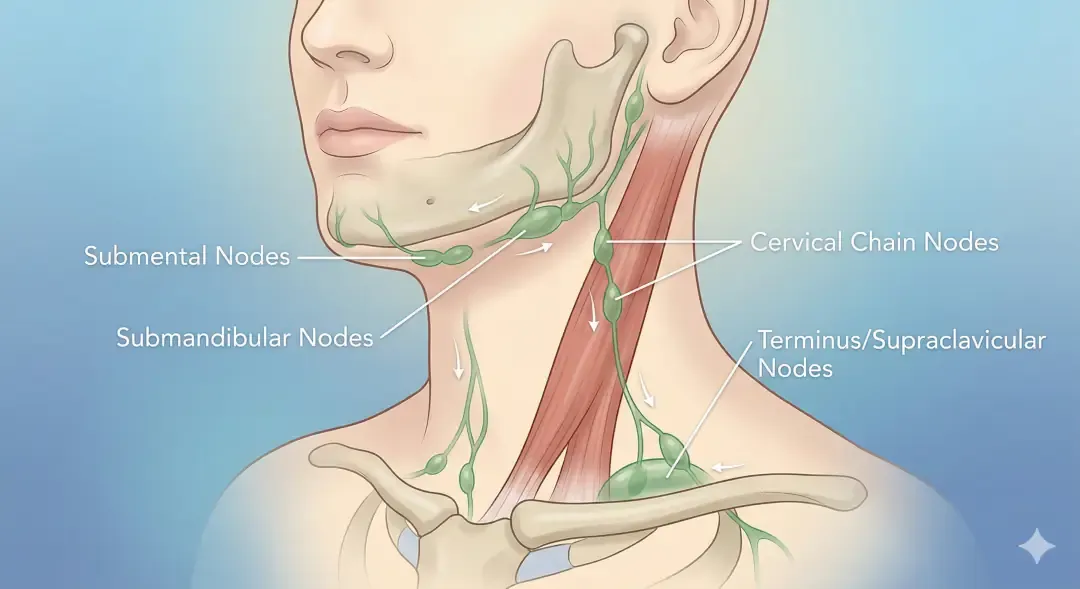
This is why, in professional facial work, we never treat just one spot. I always include the jawline, the area around the ears, and the neck, because these are the main drainage pathways. When these pathways are supported, fluid can move properly—helping to reduce puffiness and support natural facial contours.
Recent research has demonstrated the profound importance of cervical lymphatic drainage. A 2025 study published in Nature showed that gentle mechanical stimulation of facial and cervical lymphatics doubled cerebrospinal fluid outflow in aged mice, effectively restoring youthful drainage capacity. While this research focused on brain waste clearance, it highlights the remarkable responsiveness of these pathways to manual stimulation.
Therapeutic Relief: The Evidence Base
Deep facial work offers significant functional benefits supported by clinical research:
TMJ and Jaw Pain
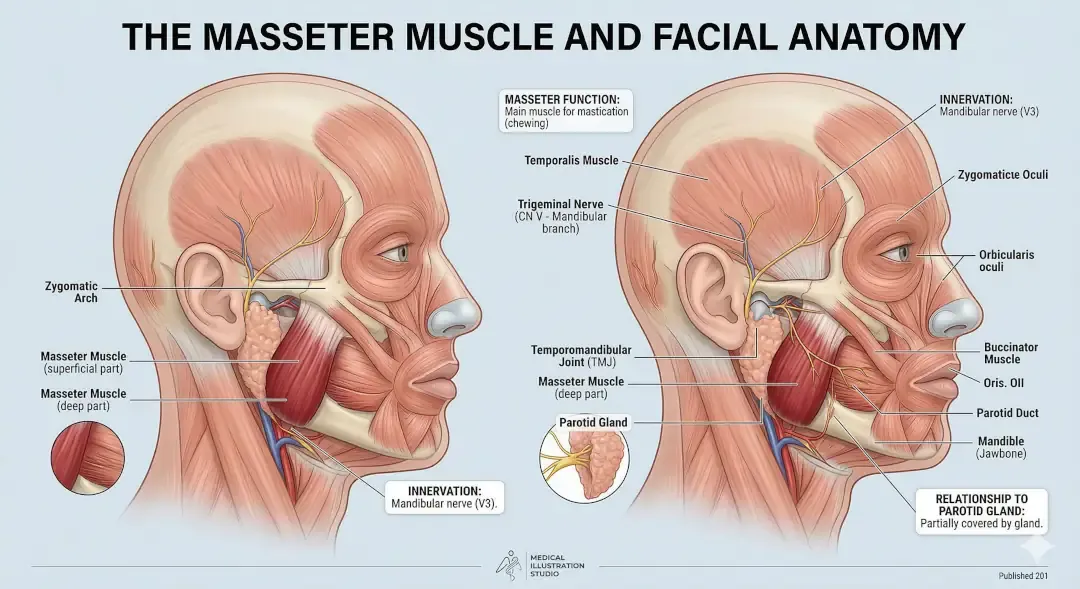
The evidence for masseter muscle massage is particularly strong. A randomised controlled trial on 82 women with tight jaw disorders found that massage combined with therapeutic exercises was the most effective treatment approach, superior to post-isometric relaxation and exercise alone. After just one treatment, pain scores dropped significantly, and by day seven, mean pain scores were nearly eliminated. Surface muscle activity confirmed significant reductions in masseter muscle tension, while ultrasound imaging showed an 85% reduction in fluid pockets and tender muscle knots.
Posture and Alignment
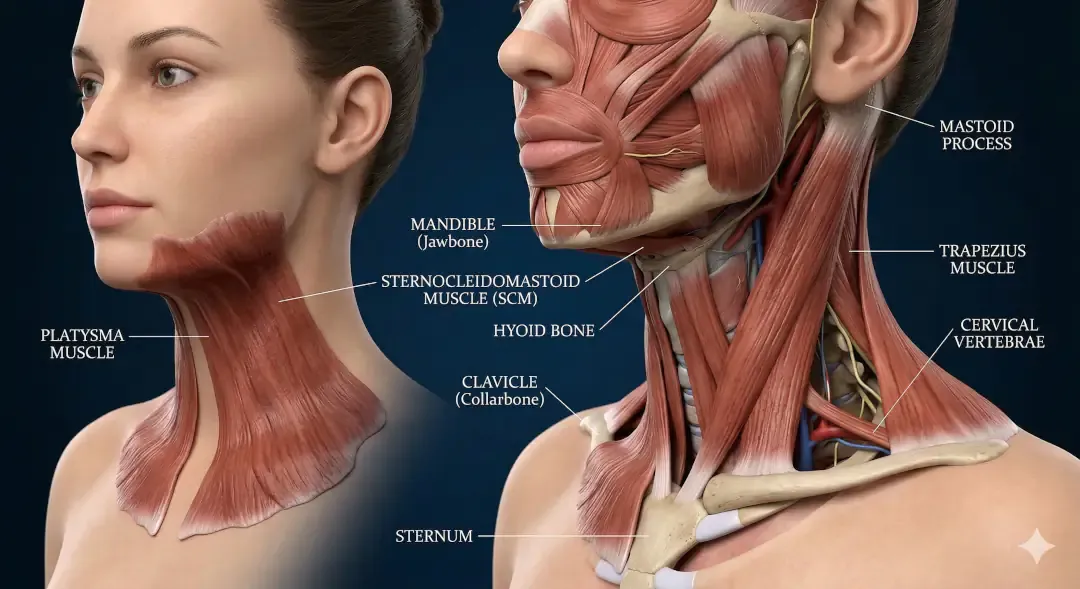
Releasing the neck muscles (such as the platysma and sternocleidomastoid) can improve head alignment and relieve the forward head posture increasingly common in our digital age. Manual therapy techniques have been shown to improve the range of motion and reduce tension in the cervical musculature.
Sinus and Tension Headache Relief
Pressure on the facial sinuses may alleviate congestion, while releasing trigger points at the temples and the base of the skull can reduce the frequency of tension headaches. Research indicates that manual therapy addressing the jaw and the muscles of the neck can significantly reduce headache frequency and intensity
The Mind-Body Reset
Perhaps the most powerful benefit of this work is its impact on the nervous system. The face is densely populated with sensory nerves. Slow, deep pressure activates touch receptors that signal the body to shift from sympathetic ("fight or flight") toward parasympathetic ("rest and digest") dominance.
This autonomic shift may lower cortisol while improving circulation, supporting tissue repair, and overall well-being. The face, after all, is not just a canvas for beauty—it reflects how we feel inside.
A Note on What This Work Can and Cannot Do
It is important to be clear about the limitations of manual therapy. Deep facial massage cannot "lift" sagging skin in the way surgical in the way surgery or machines can. It does not generate sufficient heat or mechanical force to directly stimulate collagen production. What it can do is restore tissue mobility, reduce muscle tension, improve circulation, and support lymphatic drainage—creating the conditions for your face to function and feel its best.
At its core, this approach is about structural balance. We aren't just rubbing the skin; we are rebalancing the internal tension of the face. By supporting the health and mobility of the deep connective tissues, we help you move with more ease and reflect the vitality of a body in harmony.
References
Gomes, C.A.F.P., El Hage, Y., Amaral, A.P., Politti, F., Biasotto-Gonzalez, D.A. and Oliveira, C.S. (2023) ‘Evaluation of the efficacy of manual soft tissue therapy and therapeutic exercises in patients with pain and limited mobility of the temporomandibular joint: A randomized controlled trial’, Healthcare, 11(17), p. 2362. Available at: https://pmc.ncbi.nlm.nih.gov/articles/PMC10486124/ (Accessed: 17 March 2026).
Ajimsha, M.S., Al-Mudahka, N.R. and Al-Madzhar, J.A. (2015) ‘Effectiveness of myofascial release: Systematic review of randomized controlled trials’, Journal of Bodywork and Movement Therapies, 19(1), pp. 102–112. Available at: https://pubmed.ncbi.nlm.nih.gov/25603749/ (Accessed: 17 March 2026).
Khoo Massage Therapies (no date) ‘TMJ intra-oral massage vs Botox: Why hands-on treatment gives you better results’. Available at: https://www.khoomassagetherapies.com/post/tmj-intra-oral-massage-vs-botox-why-hands-on-treatment-gives-you-better-results (Accessed: 17 March 2026).
O’Brien Physical Therapy (no date) ‘The science behind myofascial release techniques’. Available at: https://www.obrienphysicaltherapy.net/blog/the-science-behind-myofascial-release-techniques (Accessed: 17 March 2026).
Neuroscience News (2024) ‘Facial stimulation may enhance glymphatic system function’. Available at: https://neurosciencenews.com/facial-stimulation-glymphatic-29213/ (Accessed: 17 March 2026).